
September 16, 2026

Subdivision and roadway paving covers the design, site preparation, drainage, base construction, and pavement installation needed to build a street that carries repeated traffic. In Louisiana, the work is shaped by soft, moisture-sensitive soils, heavy rainfall, and the standards of whichever agency will eventually own or approve the road. Pavement type and thickness come from project-specific design and geotechnical information, not from a general rule.
A road is not a large driveway. It is a linear structure that carries repeated axle loads from mixed traffic, sheds water continuously along its length, shares a corridor with utilities, and is handed to someone who has to maintain it for decades. That last point drives more decisions than most property owners expect. The standards a street is built to, the testing that happens during construction, and the paperwork at the end all depend on who ends up owning the road.
Subdivision and roadway paving projects generally include roadway planning and design coordination, clearing and grading, subgrade preparation or stabilization, drainage systems, base construction, asphalt or concrete pavement installation, compaction and testing, and, on public projects, striping and signage. Not every project includes every step. A private access road across a stable site is a different scope from a residential subdivision street built on wet clay with curb, gutter, and storm sewer.
The owner column matters because it determines the source of the specification. A private road can be designed around the owner's budget and expected use. A street intended for public dedication has to satisfy the receiving agency's construction requirements, its testing requirements, and its acceptance process. Building a street to the wrong standard is an expensive mistake to discover at the end of a project.
Design decisions made before any dirt moves set the ceiling on how the finished road performs. Layout, width, drainage strategy, and pavement structure are connected, and changing one late in the process usually changes the others. On subdivision work, the design engineer, the developer, and the paving contractor all contribute different information, and the earlier they compare notes, the fewer surprises appear during construction.
Streets are usually classified by the function they serve. A local residential street mainly provides access to the lots on it. A collector gathers traffic from several local streets and moves it toward a larger road. An arterial carries higher volumes at higher speeds. Classification affects width, geometry, sight distance, and the traffic loading the pavement is designed for.
Layout also determines how traffic concentrates. A single entrance street feeding an entire development will carry every trip generated by that development, including garbage trucks, delivery vehicles, and emergency apparatus. Streets deeper in the development carry far less. Designing every street in a subdivision to the same section is common, but it is not automatically the most sensible allocation of budget when one street clearly carries a different load.
The right-of-way is the dedicated corridor, and it is wider than the pavement. It has to accommodate the travel lanes plus shoulders or curb and gutter, drainage ditches or storm sewer, utility placement, and in many cases sidewalks. Pavement width is only part of what the corridor has to fit.
Right-of-way and pavement width requirements come from the local subdivision ordinance or development code, and they vary between parishes and municipalities. This is one of the first items to confirm during plan review, because a corridor that is too narrow forces compromises in drainage and utility placement that are difficult to correct later.
Intersections need adequate sight distance and turning radii sized for the largest vehicle that will regularly use them. Fire apparatus, garbage trucks, and moving vans are usually the controlling vehicles in a residential subdivision, and radii that work for passenger cars can leave those vehicles tracking over curbs and pavement edges. Edge damage that shows up in the first year of occupancy often traces back to geometry rather than to the pavement itself.
Cul-de-sac turnaround dimensions are set by local code and, frequently, by the fire district. Connectivity requirements, such as a second point of access for larger developments, are also local. These are questions for the design engineer and the reviewing agency, and they should be settled before the paving scope is priced, because they change quantities significantly.
A geotechnical investigation tells the designer what the road will be built on. Borings identify soil types, moisture conditions, plasticity, and the depth of any unsuitable material. Without that information, a pavement section is a guess, and on Louisiana soils it is often an expensive one. The investigation is also what justifies the subgrade treatment approach, which is frequently the single largest variable in the budget.
Traffic design is based on repeated heavy axle loads, not on the number of households. A useful and often overlooked point: a new subdivision street usually sees its heaviest loading during home construction, when concrete trucks, lumber deliveries, and equipment haulers run over pavement that may only be days or weeks old. If the street is designed only for eventual residential traffic, that construction period can consume a meaningful share of its structural life before the first family moves in. Phasing the final surface course, protecting the base, or designing for construction loading are all worth discussing with the engineer.
Much of Louisiana sits on fine-grained, plastic clay soils that change volume with moisture and lose strength when wet. Research conducted for DOTD through the Louisiana Transportation Research Center describes the common state practice of treating or stabilizing weak subgrade soils with cement, lime, or a combination, selected according to the soil's plasticity index. Lime is generally associated with clays and cement with lower plasticity soils, though the choice is made from laboratory testing rather than from a rule of thumb.
That same research describes strength targets used to distinguish a treated working platform, which allows construction to proceed, from a stabilized subgrade layer intended to contribute support. Related LTRC work has also examined whether stabilized subgrade layers should be credited in pavement design rather than treated purely as a construction convenience. The practical takeaway for an owner is simple: soil treatment on a Louisiana roadway project is engineering, it is verified by testing, and it is not a line item to shop on price alone.
One caution worth stating plainly. Higher cement contents can increase shrinkage cracking in stabilized layers, and those cracks can eventually reflect through the surface. That is a design trade-off, handled by the engineer through additive selection and section design. It is not a reason to skip stabilization on a soil that needs it.
Louisiana DOTD publishes the Louisiana Standard Specifications for Roads and Bridges, which governs materials, construction methods, and measurement on state projects. The book was recently updated: DOTD announced that the 2026 edition is effective starting January 1, 2026; that projects letting on or before December 31, 2025 continue under the 2016 edition, and that the new edition has moved to an electronic-only format. If your project was designed earlier and is only now going to construction, it is worth confirming which edition your plans reference.
Private subdivision streets are not automatically DOTD projects. Many parishes and municipalities adopt DOTD specifications by reference for materials and workmanship, then add their own local requirements for widths, drainage, testing, and acceptance. As an illustration of how local these requirements are, one Louisiana parish's subdivision ordinance requires that streets be built in compliance with parish specifications, with certification from an approved testing laboratory and a maintenance bond from the contractor. Other parishes handle it differently. The governing document for your project is the local ordinance plus the approved plans, not a general industry practice.
It helps to keep the categories straight when someone tells you what is "required." A DOTD specification applies to work performed under it. A parish or municipal code applies within that jurisdiction. An engineer's project specification applies to that project. General industry best practice is useful guidance but carries no approval authority. These are frequently blurred in conversation, and the difference matters when a road is being reviewed for acceptance.
Most subdivision roadway projects move through a plat and engineering plan review with the parish or municipality before construction can begin. Several separate approvals commonly run alongside that review.
Licensing is worth confirming as well. The Louisiana State Licensing Board for Contractors requires a commercial license for commercial projects valued at $50,000 or more, including labor and materials. Subdivision and roadway work generally clears that threshold comfortably, so verifying a contractor's license status and classification is a reasonable early question.
If the streets are intended to become public, acceptance is a formal process rather than a handshake. It typically involves inspection during construction at defined stages, testing results submitted for review, a walkthrough and punch list, as-built drawings, and a dedication instrument recorded with the plat. Many jurisdictions then require a maintenance or warranty period backed by a bond before the agency takes over responsibility.
The practical consequence for a developer is straightforward. Until the road is accepted, it remains the developer's responsibility, including repairs. That is a strong argument for getting the testing and documentation right during construction rather than reconstructing sections later to satisfy a reviewer. It is also a reason to confirm the acceptance criteria in writing at the start of the project.
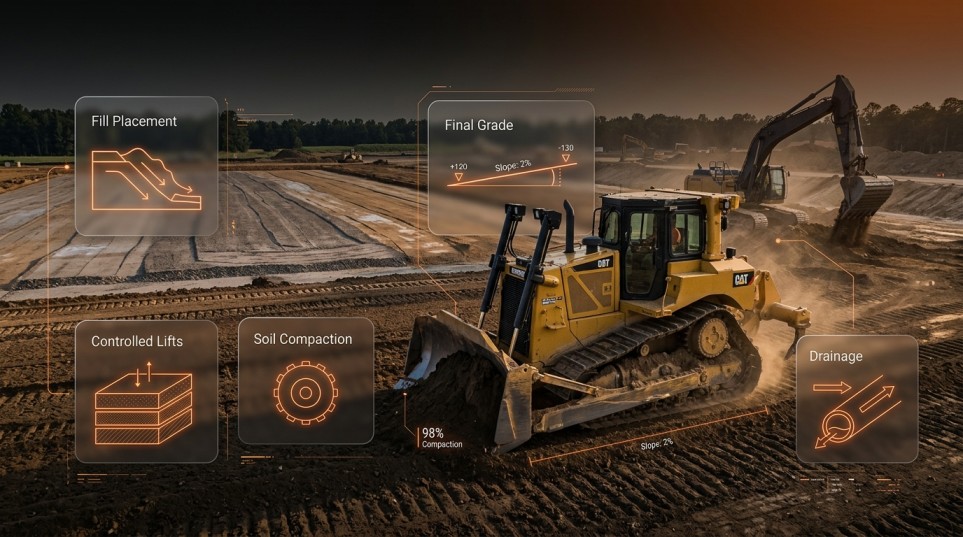
Roadway construction begins with clearing and grubbing the corridor, stripping organic topsoil, and cutting or filling to reach design grade. Organic material left under a road is a long-term settlement problem, which is why stripping depth is usually specified rather than left to judgment. Excavation quantities and the disposal or reuse of material are often significant cost drivers on Louisiana sites where fill has to be imported.
Moisture control is the recurring challenge here. Louisiana rainfall means grading crews spend real time drying material back to a workable condition, and a wet spring can extend this phase well beyond the original schedule. Grading, drainage, and pavement work are sequential, so time lost in earthwork tends to move the entire project. This phase overlaps heavily with general site preparation and dirt work, which is often scoped alongside the paving.
The subgrade is the prepared soil the pavement structure sits on, and uniformity matters as much as any single strength number. A subgrade that is strong in one section and soft in the next produces differential movement, and differential movement produces cracking regardless of how well the asphalt or concrete above it was placed. Soft areas are usually addressed by undercutting and replacing the material, by chemical treatment, or by a combination, based on what the geotechnical report and field conditions show.
Compaction requirements come from the governing project specification and are verified by testing, not assumed from experience on a previous job. It is also worth separating two measurements that sound similar and are not: soil and base compaction is expressed relative to a laboratory maximum density for that material, while asphalt density is measured against a different reference entirely. Mixing the two produces confusing conversations during construction.
Once a subgrade or treated layer is accepted, protecting it becomes part of the job. Construction traffic running across an exposed subgrade after rain can undo work that already passed testing. On phased subdivision projects, planning haul routes and staging areas around the completed sections is a practical way to protect what has already been built.
Roadway drainage design moves water off the pavement surface, along the corridor, and out to an approved outfall. The pavement is crowned or cross-sloped so water leaves the driving surface, longitudinal grade carries it along the street, and inlets or ditches collect it. On the flat terrain common across much of Louisiana, finding enough fall to reach an outfall is often the hardest part of the design, and it can influence the elevation of the entire street.
The design storm, allowable spread of water on the pavement, and outfall capacity are set by local code and by the design engineer. Proper grading and drainage planning can help direct surface water where it is intended to go, but no paving design should be presented as a guarantee that water will never stand anywhere on a road after an extreme rainfall.
Two broad approaches are common in Louisiana subdivisions. Curb and gutter with a closed storm sewer system uses less corridor width, presents a more finished appearance, provides edge support to the pavement, and concentrates flow into a piped system that must be sized and maintained. Open ditches cost less to install, need more right-of-way, and depend on ongoing maintenance to keep their section and grade.
Which one fits depends on the corridor width, the local ordinance, the receiving drainage system, and the maintenance capability of whoever will own the road. Inlet locations and spacing come out of the drainage calculations rather than from a standard interval, which is why inlet quantities can differ noticeably between two subdivisions of similar size.
Culverts carry water under the roadway or under driveways where an open ditch system is used. Sizing is a hydraulic calculation, and driveway culvert requirements in particular are usually set by the parish, which is why residents cannot simply install whatever pipe they prefer once lots are sold.
Many Louisiana jurisdictions require detention or retention for new development so that post-development runoff does not overwhelm the receiving system. Where detention is required, it is part of the development's civil design and carries long-term maintenance obligations for the owner or the HOA. Those obligations should be identified before lots are sold, not discovered afterward.
Water is the most common contributing factor in premature pavement failure, which is why state highway design manuals treat saturation of the structural section or the underlying foundation as a major cause of early failures. Saturated subgrade and base lose strength, and the same traffic that the pavement handled comfortably when dry begins to cause damage. The visible result may be edge failure, rutting, depressions, or fatigue cracking in the wheel paths.
That said, one puddle after heavy rain is not proof of a failed drainage design, and cracking near a low spot does not confirm the cause on its own. Standing water that persists, edges that break down in the same location repeatedly, or repairs that fail in the same spot are the patterns worth investigating. Determining the actual cause takes a site evaluation that looks at grades, the drainage system, and the condition of the pavement structure, not a photograph.
The base course distributes traffic loads from the pavement surface down to the subgrade. Large parts of Louisiana have limited local sources of quality aggregate, which is one reason stabilized bases built from treated in-place or hauled soils are widely used across the state rather than deep imported stone sections. Whether a project uses an aggregate base, a cement-stabilized base, or another approach is a design decision tied to the soils, the loading, and the governing specification.
Each option carries trade-offs. Stabilized bases can produce a strong, uniform platform on soils that would not support an unbound base, and they can also develop shrinkage cracks that may eventually reflect upward. Aggregate bases drain differently and behave differently under moisture. This is exactly the kind of decision that belongs with the project engineer, informed by the geotechnical report.
Asphalt roadways are built in lifts rather than in a single thick layer, because thickness affects how the mix can be compacted. A tack coat is applied between lifts to bond the layers into a single structure, and the quality of that bond matters to long-term performance. Longitudinal joints, where one paving pass meets the next, and transverse joints at the start and end of a day's work are common locations for early deterioration, which is why joint construction gets attention on roadway projects.
Mix selection is not a contractor preference exercise. The asphalt producer supplies a mix meeting the design and specification for the project, and different mixes are intended for different traffic levels, layer positions, and service conditions. Haul distance from the plant to the site affects mix temperature on arrival, which is one reason remote projects need more planning than a job a few miles from a plant.
Weather affects paving, but simple rules such as a single cutoff temperature do not apply to every project. Ambient temperature, the temperature of the surface being paved, wind, lift thickness, mix type, and the project specification all influence the available compaction window. Reputable contractors will stop when conditions fall outside what the specification and the mix allow, and that judgment is a good thing to hear during a bid conversation.
Concrete roadway pavement carries load through the slab itself, which makes the uniformity of the supporting layer critical. Jointing is the other defining element. Contraction joints are placed so the slab cracks where intended rather than randomly, and joint spacing, depth, and timing come from the pavement design. Load transfer across joints, where required, keeps adjacent slabs working together under traffic.
Curing protects the concrete while it gains strength, and opening the pavement to traffic is governed by the specification and by strength verification rather than by a fixed number of days that applies everywhere. On projects where a road has to reopen quickly, opening criteria should be discussed during design, not negotiated on site after placement.
Compaction is one of the strongest predictors of how long a pavement performs, and it is also one of the most misunderstood items on a project. There is no universal percentage that applies to every layer of every road. Requirements come from the governing specification for that project and that material, and they are demonstrated through testing rather than through rolling patterns.
More rolling is not automatically better either. Compaction of asphalt depends on the mixture, mat temperature, lift characteristics, roller type and sequence, and timing. Rolling outside the workable window can do nothing useful, and in some cases can damage the mat. What an owner should expect is a documented approach that meets the specification and testing that confirms it, not a promise about a specific number before the work starts.
Both materials build successful roads in Louisiana. The comparison below describes general tendencies, and any of these can shift on a specific project depending on quantities, haul distance, soils, loading, and current material pricing.
The choice is rarely about which material is better. It is about which one fits the loading, the soils, the budget structure, and the maintenance capability of the eventual owner. A few questions usually settle it.
It is also common to mix approaches, using concrete at intersections, entrances, or truck turning areas while paving the rest of the roadway in asphalt. That decision belongs to the design engineer with input from the owner about how the road will actually be used.
Testing is how a road proves it was built the way the plans said it would be. On projects headed for public acceptance, testing is not optional paperwork; it is the evidence the reviewing agency relies on. On private projects, testing is what protects the owner, since nothing about a finished surface reveals what is underneath it.
Subgrade and base layers are typically tested for density and moisture at frequencies set by the specification. Proof rolling, where a loaded vehicle is run across the prepared surface while it is observed for movement, is used on many projects as a practical check for soft areas that testing at discrete points might miss. Where stabilized layers are used, strength testing may also apply.
One question worth asking early is who pays for and who selects the testing laboratory. On many local projects, the developer retains an independent laboratory, and the results go to the reviewing agency. Clarifying this up front avoids arguments about disputed results later.
Asphalt testing commonly addresses the mix as produced and the mat as placed, including density and, on some projects, cores taken from the finished pavement. Concrete testing commonly includes cylinders cast for strength verification and fresh property checks at placement. Sampling frequencies come from the specification, and the roles are separate: the producer supplies the material, the contractor places it, and an independent laboratory verifies it.
Thickness may be verified by cores, by measurement during placement, or by quantity reconciliation, depending on the specification. Documentation typically includes delivery tickets, daily construction reports, test results, and as-built drawings showing what was actually built and where drainage structures ended up.
That documentation has a long life. When the road needs rehabilitation in fifteen years, knowing the existing section, the base type, and the drainage layout changes the options available and the accuracy of the estimate. Owners who keep their construction records make far better maintenance decisions later.
Roadway pricing is project-specific, and any figure quoted without plans, quantities, and site information is a placeholder rather than an estimate. What can be explained clearly is where the money goes and why two proposals for the same road can differ substantially.
On many Louisiana subdivision projects, the work below the pavement surface represents the larger share of the cost. Clearing, excavation, hauling and importing fill, removing unsuitable material, chemical treatment of the subgrade, drainage structures, pipe, and base construction all happen before a paver arrives. These are also the items most affected by site conditions, which is why a geotechnical report improves the quality of every estimate that follows.
Drainage in particular can swing a budget. A site with a nearby outfall and adequate fall is a different project from one requiring detention, deep storm sewer, or an extended outfall easement across adjacent property.
Pavement type and section thickness drive material quantities directly. Length and total area determine how mobilization, traffic control, and testing are spread across the work, which is why small projects usually carry a higher cost per unit area than large ones. Haul distance from the asphalt plant or concrete supplier affects both price and scheduling. Phasing adds cost as well, since a road built in three stages involves more mobilizations than the same road built at once.
A roadway estimate is generally built from quantities taken off the approved plans, priced by unit: cubic yards of excavation, square yards of subgrade treatment, tons of base or asphalt, linear feet of pipe and curb, each drainage structure, plus mobilization, traffic control, testing, and any striping or signage. Allowances or unit prices are usually included for items that cannot be known until the ground is opened, such as unsuitable material removal.
When you compare proposals, compare scope before comparing price. A lower number often reflects a thinner section, less subgrade treatment, less drainage work, fewer testing allowances, or exclusions buried in the fine print. Useful items to line up side by side include the pavement section and lift thicknesses, subgrade treatment, base type and depth, drainage structures and pipe, testing, traffic control, striping, restoration, and the list of exclusions. Price per square yard by itself tells you very little, because it says nothing about what is under the square yard.
Roadway projects follow a predictable sequence even though the duration of each phase varies widely by jurisdiction, project size, and weather. Design and geotechnical investigation come first, followed by agency plan review and permitting, which is frequently the least predictable phase because it depends on review cycles and how many comments come back.
Construction then proceeds through clearing and earthwork, drainage installation, subgrade preparation and any treatment, base construction, paving, and finally striping and cleanup. Stabilized layers generally need time to gain strength before the next layer is placed, and concrete needs time before it opens to traffic. Testing and inspection occur throughout rather than only at the end. Final acceptance follows the punch list, documentation submittal, and any required maintenance period.
No responsible contractor can commit to a total duration before seeing plans, quantities, and site conditions. What you can reasonably ask for is a phase-by-phase schedule tied to your specific scope, with weather assumptions stated openly.
The most common delays on Louisiana roadway work are weather-related. Rain does not just stop work on the day it falls; it leaves earthwork requiring drying time before grading and testing can resume. Beyond weather, the recurring causes are utility conflicts discovered during excavation, plan revisions after agency review comments, unsuitable soils found once the corridor is opened, material or testing results that require rework, delayed access to portions of the site, and permit review timelines outside anyone's control.
Two of these are partly manageable. Utility conflicts are reduced by early coordination and locating before excavation begins. Unsuitable soil surprises are reduced by an adequate geotechnical investigation. Both cost money at the front of a project and typically save more than they cost.
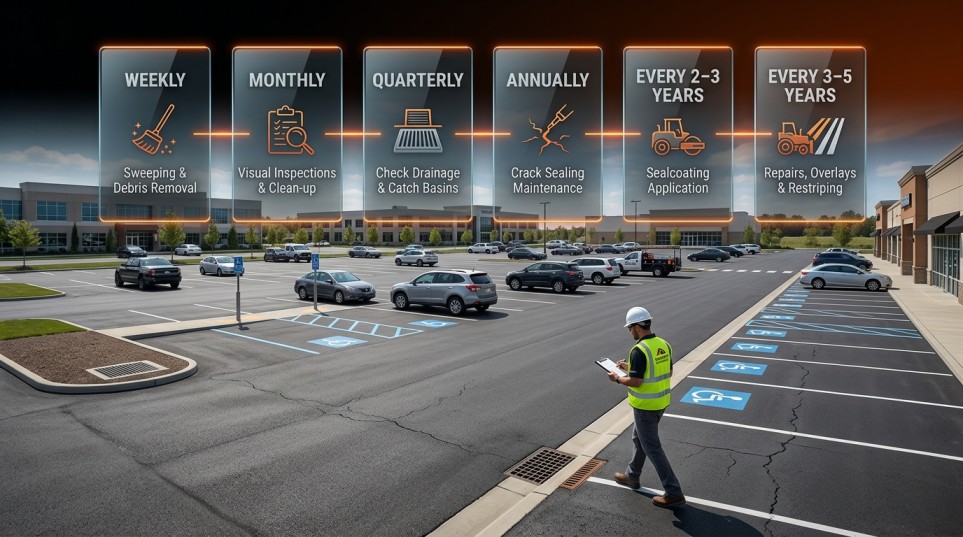
Once a road is in service, the goal shifts to keeping the structure sound and the water out. Treatments are not interchangeable, and applying the wrong one produces short-lived results that cost more over time than the correct treatment would have.
Sealing cracks keeps surface water from reaching the base and subgrade, which is the main reason it is worth doing early rather than late. It is a preventive treatment for a sound pavement with defined cracks. It does not restore structural capacity, and it is not the right response to widespread fatigue cracking across the wheel paths.
Patching addresses localized failures. The distinction that matters is depth. A surface patch addresses a shallow defect, while a full-depth repair removes and replaces the failed material through the pavement structure. Where potholes keep returning in the same location, the reason usually sits below the patch, in water, base condition, or loading, and repeated patching without investigating that will keep producing the same result. This work connects to crack and joint sealing and asphalt patching and repair services.
Milling removes deteriorated surface material and restores the profile, and it is also how elevations are managed. That elevation point is important on subdivision streets. Placing an overlay without milling raises the surface, which reduces curb reveal, changes how gutters carry water, and can affect drainage along the entire street. On a curbed roadway, milling before overlay is frequently about geometry as much as about the condition of the old surface.
An overlay improves the riding surface and can restore some structural capacity depending on the design. It does not correct a failed base, severe fatigue cracking across large areas, or a drainage problem. Those conditions need to be addressed separately, or the new surface will reflect the same distress within a short time. Whether mill and overlay or a heavier rehabilitation is the better value depends on the evaluation, not on a general assumption that the lighter treatment is cheaper in the long run. Related work is covered under milling and asphalt overlay services.
Reconstruction is considered when the problem is in the structure rather than the surface. Indicators that point that way include widespread fatigue cracking across large areas rather than isolated spots, repeated failure of previous repairs, base or subgrade problems confirmed by investigation, drainage or elevation issues that cannot be corrected from the surface, and a road that no longer matches the loading it now carries.
Age by itself is not an indicator. A twenty-year-old street with sound structure and good drainage may need resurfacing, while a much newer road with a saturated base can need reconstruction. Deciding between them takes a site evaluation, and often coring or other investigation, so that the money goes toward the actual problem.
Subdivision and roadway paving succeeds or fails on the decisions made before the surface goes down. Understand what the soils require, settle the drainage strategy early, confirm which agency's standards apply and what acceptance will involve, and compare proposals on scope rather than on a unit price. Those four things account for most of the difference between roads that hold up and roads that need attention far too soon.
If you are planning a subdivision street, a private or access road, a commercial roadway, or the rehabilitation of an existing road, the useful next step is having someone walk the site and look at the plans with you. Precision Blacktopping LLC is a family-owned paving and pavement maintenance contractor based in Pineville, Louisiana, serving Louisiana, Mississippi, and Texas, with services including asphalt paving, concrete paving, roadway work, site and dirt work, resurfacing, sealcoating, crack and joint sealing, and pavement markings.
Call (318) 955-3100 or request a free estimate or on-site assessment to talk through your project, your site conditions, and the approach that fits what you are actually building. Bring your plans and any geotechnical information you have, and the conversation will be far more useful than a number quoted over the phone.
.png)