
August 18, 2026
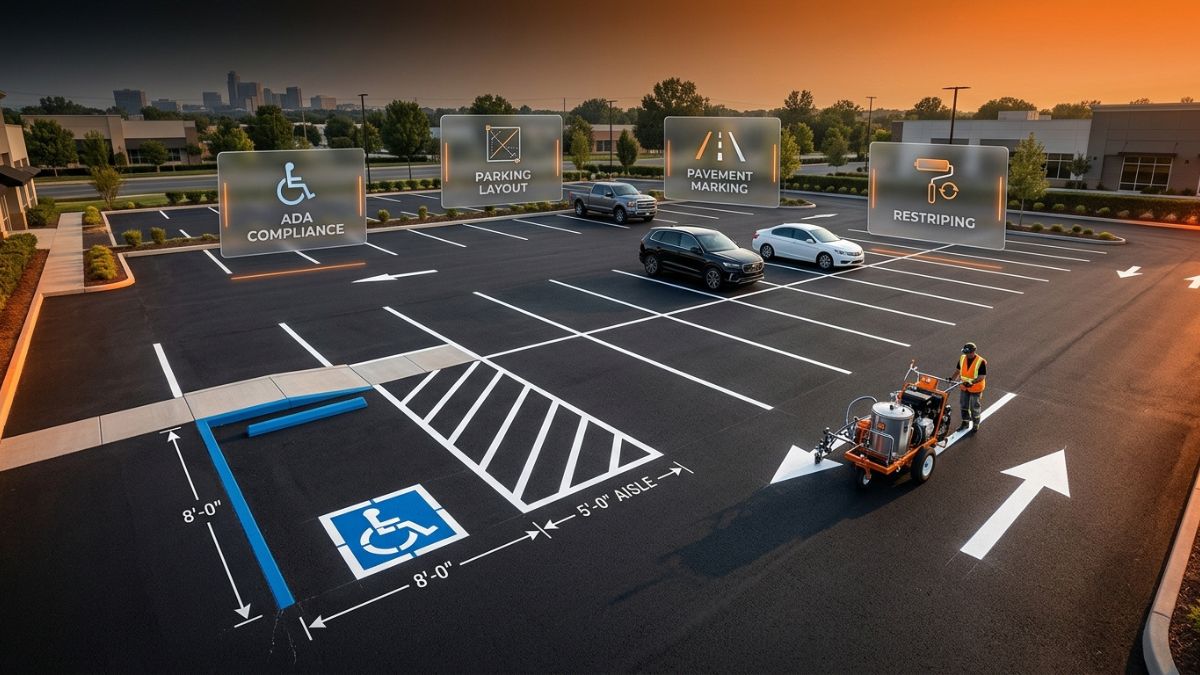
Parking lot striping is the layout and application of the lines, symbols, arrows, and legends that tell drivers and pedestrians how your lot works. Requirements come from several places at once: the federal ADA Standards, Louisiana statute, your local zoning ordinance, and your local fire authority. Because restriping can trigger accessibility obligations, the layout is worth reviewing on site before any paint goes down.
Key Takeaways
Most lots in Central Louisiana get restriped because the lines have faded, not because anyone planned for it. That timing matters, because the restripe is the one moment when the layout is genuinely easy to change. This guide covers what the markings mean, which requirements apply to a private commercial lot in Louisiana, how layout affects capacity, which materials are worth paying for, and how striping should be sequenced with the rest of your pavement maintenance.
Striping and pavement marking are the visible traffic control layer of a paved site. Everything below the surface carries the load, but the markings are the only layer drivers actually read and follow.
In everyday contractor language, the terms are interchangeable. Reading a proposal is where the distinction matters. Striping normally means the linear work: stall lines, double lines, edge lines, and hatched areas. Pavement marking is broader and takes in arrows, stop bars, crosswalks, fire lane legends, the International Symbol of Accessibility, curb painting, and applied products like preformed tape. A bid quoted per stall may cover only the stall lines, with legends and symbols priced separately, so two proposals can look far apart and cover identical work.
Markings set the conflict points in a lot: where vehicles cross, where pedestrians walk, where drivers stop, and which direction traffic moves. Without arrows and stop bars, every one of those decisions is left to the individual driver. Layout also determines capacity, since stall angle, stall width, and aisle width together decide how many vehicles a given area holds. Compliance is where the financial exposure sits, because accessible parking and emergency access are both governed by published requirements. Appearance is the reason owners usually call, and faded markings tend to be read by tenants and customers as deferred maintenance across the property.
Color on pavement is a language drivers learn on public roads and then apply everywhere else. The federal Manual on Uniform Traffic Control Devices sets the framework in Section 3A.03 of its 11th Edition: markings are yellow, white, red, blue, or purple, with blue used to supplement white markings for accessible parking spaces. The MUTCD governs roads open to public travel rather than private lots, so a commercial lot is not automatically bound by it. That is a technical distinction, not a license to improvise, since drivers still read your lot using habits formed on public roads.
Custom stencils cover the operational side of a lot: reserved spaces, curbside pickup bays, EV charging stalls, drive-through queue lines, school and church loading areas, and motorcycle spaces. These are business decisions rather than code requirements, and they are worth planning alongside the restripe, since a stencil added later means a second mobilization. One distinction is worth keeping straight. Markings that create a legal restriction, such as fire lane legends and accessible symbols, carry requirements. Operational markings do not, but they should not contradict a standard meaning, and blue should not be used for anything other than accessible parking.
These are the two areas where a striping decision creates real exposure. What follows describes published requirements and does not evaluate any specific lot. The U.S. Department of Justice states in its compliance brief on restriping parking spaces that when a business or government entity restripes a lot, it must provide accessible parking as required by the 2010 ADA Standards, and that because restriping is relatively inexpensive, removing barriers this way is readily achievable in most cases. In practical terms, restriping is when the accessible layout gets evaluated.
The required count comes from Table 208.2 of the 2010 Standards. Two details are commonly missed: the count is calculated separately for each parking facility rather than from the site-wide total, and one of every six accessible spaces, or a fraction of six, must be van accessible.
Medical uses have their own scoping under Section 208.2 of the 2010 ADA Standards. Ten percent of patient and visitor spaces serving hospital outpatient facilities must be accessible, and twenty percent applies to rehabilitation facilities specializing in mobility conditions and to outpatient physical therapy facilities. A medical tenant moving into a retail center can change the requirement even though nothing about the pavement did.
A car parking space is 96 inches wide minimum, marked to define the width. A van space is 132 inches wide minimum with an adjacent access aisle 60 inches wide minimum, or alternatively 96 inches wide with a 96-inch access aisle. Both van configurations are permitted.
The access aisle must be at least 60 inches wide, extend the full length of the spaces it serves, sit at the same level as those spaces, adjoin an accessible route to the entrance, and be marked to discourage parking in it. It must not overlap the vehicular way. Two spaces may share one aisle, except for angled van spaces, where the aisle belongs on the passenger side.
The requirement that catches owners off guard is slope. The maximum is 1:48 in all directions, roughly two percent, for both the space and the aisle. That is a pavement geometry condition, so if an area drains at four percent, the accessible spaces need to go somewhere else or the grade needs correcting. Checking with a level during layout is quick; discovering it after the symbols are painted is not. Note also that van spaces, their aisles, and the route serving them require 98 inches minimum vertical clearance, which matters under canopies and drive-through overhangs.
Each accessible space is identified by a sign displaying the International Symbol of Accessibility, mounted at least 60 inches above the ground measured to the bottom of the sign, with van spaces carrying the designation "van accessible." Where four or fewer spaces are provided on a site, that sign is not required, though the space still must be van accessible. Guidance from the U.S. Access Board covers these provisions in more detail.
Louisiana adds a requirement on top of the federal standard that striping proposals frequently overlook. Under La. R.S. 40:1742, each access aisle or adjacent loading area must have "NO PARKING" painted on the pavement in letters not less than twelve inches tall. It applies to newly constructed spaces and to existing spaces repainted after August 1, 2013. The same statute allows a fine of up to five hundred dollars for failing to provide and maintain reserved accessible spaces free of obstructions, and it preserves the right of parishes and municipalities to adopt their own accessible parking ordinances.
Fire lane expectations are more local than most property owners assume. The Louisiana Office of State Fire Marshal enforces the codes tied to the Louisiana State Uniform Construction Code, which include NFPA 101 Life Safety Code, 2015 edition, the fire protection and egress provisions of the adopted construction codes, and the 2010 ADA-ABA Accessibility Guidelines. The LSUCC building codes are the 2021 International Building Code and companion codes, not a statewide fire code adoption covering private lot striping.
So there is no single statewide specification to look up. Whether fire lane markings and signage are required at your property, how wide the lane must be, what color it is painted, and what the legend says are questions for the authority having jurisdiction, normally the municipal fire prevention bureau in Alexandria or Pineville, the parish authority, or the State Fire Marshal depending on occupancy. Confirm this before the layout is set, particularly if you are considering narrowing a drive aisle to gain stalls.
A short verification list before layout saves rework. Working through these with your contractor is usually a matter of a few phone calls.
There is no single national standard for stall size in a private lot. Dimensions come from local zoning ordinances and vary between jurisdictions. The ranges below are commonly written into municipal ordinances and used in commercial site design. Treat them as a planning reference and verify the governing numbers for your property. The underlying trade-off is straightforward: as the parking angle decreases from 90 degrees, drivers maneuver more easily, and the aisle can be narrower, but each row consumes more length per stall, and the aisle usually becomes one-way.
Angled parking and one-way circulation belong together. When stalls are angled but the aisle carries two-way traffic, drivers approaching from the wrong direction face stalls they cannot comfortably enter, and some will try anyway. Ninety-degree stalls work naturally with two-way aisles because the approach is symmetrical. One-way circulation only works if a first-time visitor reads it correctly at the entrance, which means arrows at every entry point and repeated through the aisle.
Real gains usually come from re-angling rows or reorganizing the module, meaning the combined width of two stall rows plus the aisle between them. Converting an oversized drive aisle, adding a short row at a dead end, or picking up parallel stalls along an underused perimeter are all options a measured layout will reveal. What creates problems is shaving from what the lot cannot spare: stall width below the ordinance minimum, aisle width below what emergency access requires, or the access aisle and pedestrian route to the entrance. Truck paths and dumpster access are also commonly squeezed, and both reassert themselves the first time a trailer cannot make the turn.
Waterborne traffic paint handles the large majority of commercial lot work. It applies with standard airless equipment, dries relatively quickly in warm conditions, restripes cleanly over existing markings, and costs less per stall than the durable systems. The durable materials earn their place in specific locations rather than across a whole lot. One caution on service life: the durability figures published by state transportation agencies, including the TxDOT Pavement Marking Handbook, describe highway conditions. A parking lot has lower speeds but far more turning and tire scrubbing, so use agency figures for relative comparison rather than as a prediction.
Thermoplastic and epoxy generally require a clean, dry, cured, uncoated surface, and thermoplastic in particular is not used to restripe directly over existing paint. That makes them planning decisions tied to a resurfacing or a full relayout.
Architectural paint is formulated for a vertical surface that nothing drives across. Traffic paint is formulated for abrasion, tire contact, and UV exposure on a horizontal surface. Use traffic-rated pavement marking products selected for the surface and the application conditions, and expect anything else to wear through at the tire tracks within a season.
The first question on any striping job is whether the surface can hold paint. Asphalt that has oxidized and started to ravel is losing fine aggregate, and paint applied to it leaves with the material it bonded to. Areas with active cracking, failed patches, or standing water need a decision before layout. Cleaning is not a formality either, since dust, oil-stained areas, vegetation in cracks, and residual moisture all prevent bond. In Central Louisiana, the moisture question comes up more often than the temperature one.
For a straight restripe, the existing layout is captured so new lines land on the old ones. A new layout is closer to site design, with overall dimensions measured and stall positions chalked before any paint is applied. This is the stage where compliance is either built in or missed. Accessible spaces need to sit on the shortest accessible route to an accessible entrance, on ground that meets the slope limit, with access aisles that connect to that route without crossing the vehicular way.
Lines are applied with an airless striping machine that holds consistent width and film thickness, with glass beads applied into the wet paint where specified. Arrows, legends, accessible symbols, and fire lane wording go down with stencils, and curb work is done by hand. Weather governs the schedule more than the calendar does, and the controlling numbers for surface temperature and moisture come from the manufacturer data sheet for the specific product.
Dry to touch and fully cured are different states. Waterborne paint can be walkable quickly in warm, dry conditions and much slower when humidity is high, which is the normal condition through a Central Louisiana summer. Reopening too early produces tracked lines and thin spots at the stall entries. Ask your contractor for the reopening window for the product and the conditions on the day rather than working from a fixed number, and keep parked vehicles from turning their wheels on fresh markings.
Duration depends far more on scope than on square footage. A restripe that follows existing lines moves quickly because there is no layout time, while a new layout on the same lot takes considerably longer.
Most occupied properties are striped in sections: a portion is coned off, striped, and held until it can be released. Retail centers and medical offices are often scheduled early in the morning or after hours, while churches and schools can frequently give up a full day. Sectioning usually adds time and sometimes a mobilization, and it only works if tenants and staff are told which areas are closed and when.
Striping is priced from scope, and published averages are close to useless for budgeting because they rarely say what is included. Understanding the pricing structure is what lets you compare two proposals accurately.
Restriping a conventional lot is often quoted at a rate per stall, which works when the layout already exists and the stalls are uniform. Work that is not stall lines, such as edge lines, hatching, and long directional lines, is more naturally quoted per linear foot, while full layouts and mixed scopes are usually a lump sum. The unit rate alone tells you little. Compare what sits behind it: line width, single or double lines, one coat or two, glass beads, arrows and stop bars, curb painting, accessible symbols and aisle work, sign supply and installation, removal of old markings, and mobilization.
A restripe follows what is already there, so the cost is mostly application time. A new layout adds measurement and usually adds removal, since old lines have to stop competing with new ones. Removal is normally grinding or blackout, and the two behave differently: grinding removes the marking but can scar the asphalt, while blackout covers the line and can ghost through over time. A relayout can also surface compliance work that a restripe would not, such as adding a van space, widening an aisle, adding the twelve-inch lettering Louisiana requires, or relocating spaces to ground that meets the slope limit. Precision Blacktopping provides free estimates and on-site assessments for parking lot maintenance and striping across Central Louisiana.
Traffic volume matters, but the type of traffic matters more. Stalls wear at the entry point where tires scrub during turn-in, drive lanes wear along the wheel paths, and areas where trucks turn under load wear fastest. A 200-stall lot with light turnover can outlast a 60-stall lot serving a busy quick-service restaurant. The surface underneath sets a ceiling on marking life, and film thickness, number of coats, and whether beads were used all shift the result. Sun exposure fades color across the whole lot, and areas that hold standing water typically lose markings early.
Some restripes should not repeat the old layout. A tenant change can alter both the required parking count and the required accessible count, particularly with a medical use. Adding a drive-through lane, curbside pickup, EV charging, or a new dumpster enclosure changes circulation, and a new entrance changes where the accessible route runs. The most common case is simpler: the lot was never laid out to current standards, and nobody has revisited it. Correcting that while the crew is already mobilized costs a fraction of correcting it later.
Striping is the last step in a maintenance sequence. On new asphalt, a waiting period is normally observed before permanent markings go down, and solvent-based products in particular can bleed on a fresh surface. After sealcoating, the sealer must be fully cured rather than merely dry, which commonly means a full day or more and longer in humid conditions. The working order is repairs, then sealcoat, then a full cure, then striping. Our seal coating and parking lot maintenance services are scheduled with that sequence in mind.
Paint bonds to whatever it lands on, so localized problems are usually worth addressing first, particularly where a repair falls inside a stall footprint. Widespread distress is a different conversation that points toward evaluating the pavement structure. Timing works both directions: if resurfacing is likely within the year, a maintenance restripe can carry the lot until then. Our pavement repair and patching work is normally scoped alongside striping for that reason.
The recurring errors are counting accessible spaces site-wide instead of per facility, missing or undersized van spaces, access aisles that are too narrow or stop short of the full stall length, missing twelve-inch "NO PARKING" lettering, signs mounted too low, accessible spaces placed where the slope exceeds the limit, and drive aisles narrowed for stalls without confirming emergency access.
Painting over dust, oil, or a surface that has not dried produces markings that lift within months. Striping a lot scheduled for resurfacing shortly afterward wastes the work entirely. Leaving conflicting old lines in place when the layout changes leaves drivers reading two layouts at once, which is worse than either alone.
On materials: a product chosen for price rather than surface and season, a single thin coat where two were needed, and no beads where night visibility matters. On layout: angled stalls served by two-way aisles, arrows that fight the geometry of the entrance, and a pedestrian route running the length of a row behind backing vehicles.
DIY is practical for very small, simple private markings: a handful of stalls with no public access and no accessible parking obligation, where existing lines are still visible enough to follow. Layout accuracy is harder than it looks once lines have faded, and the work area needs to be fully closed rather than worked around moving vehicles.
For any lot serving the public, the difference is compliance exposure rather than paint quality. Accessibility, traffic flow, surface preparation, and local fire and zoning requirements all need to be considered together, and a lot repainted in Louisiana after August 1, 2013 carries the access aisle lettering requirement whether or not anyone knew about it. If you manage a commercial, retail, church, medical, industrial, or multi-family property in Central Louisiana, Precision Blacktopping provides free estimates and on-site assessments.
There is no single national standard for private lots. Dimensions come from the local zoning ordinance, and commonly used figures fall around nine feet wide by eighteen to twenty feet deep for a 90-degree space. Verify the governing numbers for your municipality or parish before layout.
The minimum comes from Table 208.2 of the 2010 ADA Standards, calculated separately for each parking facility rather than site-wide. A lot with 1 to 25 spaces needs at least one, and one of every six accessible spaces must be van accessible. Certain medical uses require ten or twenty percent of patient and visitor spaces.
It depends on traffic, material, and pavement condition rather than a fixed schedule. Many commercial lots using waterborne paint fall into a one- to two-year cycle. Condition is the better trigger: restripe when stall entries have faded, when drivers stop parking within the lines, or when accessible markings are no longer clearly readable.
Yes, and that is the correct order. The sealer needs to be fully cured first, commonly at least a full day and longer in Central Louisiana humidity. Painting over uncured sealer risks poor bond and discoloration. Follow the sealer manufacturer guidance rather than a fixed number of hours.
A straight restripe that reproduces the existing layout usually does not, though this varies by jurisdiction. Changing the layout is different, since stall counts, circulation, and accessible parking may be tied to the approved site plan. Confirm with the local planning office before a relayout, and confirm fire access separately.
The requirements that carry real weight on a striping job are specific and verifiable: the accessible space count per parking facility, the van space and access aisle dimensions, the slope limit, the Louisiana access aisle lettering rule, and whatever your local fire authority requires. Everything else is judgment about how your property is actually used. If your lot is faded or you are unsure whether the accessible parking is configured correctly, contact Precision Blacktopping for a free estimate or an on-site assessment.
.png)