
July 30, 2026

Crack and joint sealing is a pavement maintenance treatment that fills cracks and gaps with a flexible sealant to keep water, dirt, and debris out. In Central Louisiana, where heavy rain and hot, humid summers stress asphalt and concrete year-round, sealing cracks early stops small problems from turning into potholes, base failure, and costly full repaving.
Your driveway or parking lot is cracking, and you are not sure if it is a small fix or the start of a much bigger bill. That crack you noticed last month is probably wider now. In Central Louisiana, cracks do not sit still. Rain gets in, the sun bakes the edges, and traffic keeps pounding the same weak spot until it turns into a pothole.
We have sealed driveways and parking lots across Pineville and the surrounding parishes for years, and we have seen what happens when small cracks get ignored through even one Louisiana summer. The good news is that crack and joint sealing is one of the most affordable ways to stop that damage before it spreads.
In this guide, you will learn what crack and joint sealing actually does, why it matters so much in our climate, how to tell if your pavement needs it, what the process looks like step by step, and when it makes more sense to call a professional than to tackle it yourself.
Crack and joint sealing is the process of placing a flexible adhesive material into cracks and joints on asphalt or concrete surfaces to block water and debris from getting underneath the pavement. It is a maintenance step, not a repair for pavement that has already failed.
Water is the real enemy here. Once it seeps through a crack, it softens the base layer underneath. That base is what holds your pavement up. A soft base flexes under traffic, and a flexing base leads to bigger cracks and eventually a pothole.
The sealant creates a watertight barrier that also flexes as the pavement expands and contracts. Asphalt and concrete move constantly with temperature swings, so a rigid filler would crack right back open within a season. A properly installed sealant stretches and compresses along with the surface, which is why the material choice and installation method both matter.
Crack sealing and crack filling get used interchangeably in casual conversation, but they are different treatments for different problems.
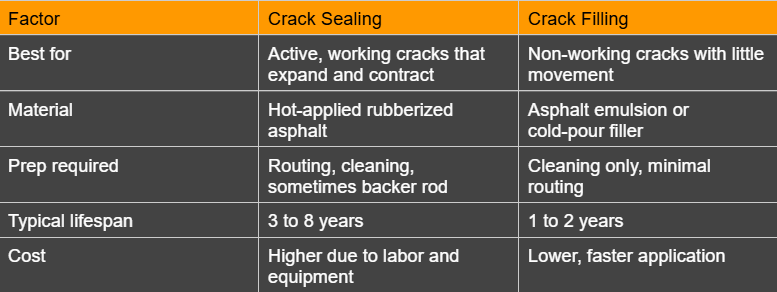
If a contractor sells you crack filling for a crack that is actively opening and closing with the seasons, you are paying for a fix that will fail fast. Matching the treatment to the crack type is the first decision that determines how long the work lasts.
Every region has its own climate stress, and Central Louisiana throws a mix of the worst offenders at pavement: heavy rain, intense heat, humidity, and soil that moves.
Central Louisiana sees a high number of rainy days across the year, and that rain does not just sit on the surface. It finds every crack and works its way down to the base. Once water reaches the base layer, it erodes support from underneath the pavement, and that erosion is invisible until the surface starts to sag or collapse.
Sealed cracks shed that water instead of absorbing it. This one factor is why local pavement fails faster than pavement in dry climates when maintenance is skipped.
Summers here push pavement surface temperatures well past the air temperature, and constant UV exposure dries out the asphalt binder over time. As the binder dries, the surface loses flexibility, and cracks form even without heavy traffic.
Louisiana also gets enough cold snaps for freeze-thaw cycling to matter. Water that has seeped into a crack expands when it freezes, then contracts when it thaws. That repeated push and pull widens cracks fast, especially during the unpredictable cold spells we get most winters.
Much of Central Louisiana sits on clay-heavy soil that swells when wet and shrinks when dry. That movement transfers straight into whatever pavement sits on top of it, which is a major reason cracks reappear even after a repair.
Traffic loads add to the pressure, particularly for commercial lots with delivery trucks or repeated turning movements. Left unsealed, weeds and grass will root inside a crack and force it wider from the inside out.
This is the number that gets property owners' attention: for every dollar spent on crack sealing, studies show property owners save up to six dollars in future repair costs (Source: SealMaster FAQ data). A full repaving project runs several dollars per square foot, while crack sealing runs closer to a dollar or two per linear foot.
Think of it like a small leak in a roof. You can patch it for a few hundred dollars now, or you can wait and replace the whole roof after water damage spreads. Pavement works the same way.
Longitudinal cracks run parallel to traffic flow and usually come from paving seams or base settlement. Transverse cracks run across the pavement, perpendicular to traffic, and typically form from temperature shrinkage. Block cracking shows up as large rectangular sections, usually caused by the asphalt binder aging and drying out.
Alligator cracking, which looks like a reptile's scaled skin, is not on this list on purpose. That pattern signals base failure, and sealing alone will not fix it. We cover that distinction in the next section.
Concrete slabs are poured with intentional gaps called joints. Expansion joints give the slab room to grow in the heat. Contraction joints control where the concrete cracks as it shrinks while curing, keeping the crack in a straight, predictable line instead of a random spot. Isolation joints separate the slab from fixed structures like buildings or light posts so the two surfaces can move independently.
Every one of these joints needs sealant to keep water out, just like a crack does. Skipping joint sealing on a concrete driveway or sidewalk is one of the most common maintenance gaps we see.
Fresh hairline cracks, spreading networks of cracks, and old sealant that has pulled away, hardened, or cracked itself are the most obvious signs. Sealant does not last forever. If a crack was sealed years ago and the material has shrunk or lifted at the edges, water is getting through again.
Walk your pavement the day after a heavy rain. Puddles that linger along a crack line, dark wet streaks radiating from a crack, or crumbling asphalt at the crack edges all point to water already working its way into the base.
If grass or weeds are growing directly out of a crack, that crack has been open and collecting organic debris for a while. Roots widen the crack further as they grow, so this sign usually means the problem has moved past a simple, cheap fix.
No, not every crack can be sealed. This is where a lot of DIY projects go wrong, and where cheap contractors cut corners.
Industry guidance from state transportation agencies generally targets cracks between roughly 0.1 and 1 inch wide for sealing, with wider cracks up to about 1.5 inches sometimes qualifying with extra prep work (Source: Caltrans Maintenance Technical Advisory Guide). Cracks that open and close noticeably with the seasons, known as working cracks, need a flexible hot-applied sealant. Cracks with very little movement can often be handled with a simpler cold-pour filler instead.
This is the most important distinction on this list. Non-structural cracks affect only the surface and respond well to sealing. Structural damage, like alligator cracking, potholes, or sunken sections, means the base underneath has already failed. Sealant cannot fix a broken foundation any more than paint can fix a cracked wall.
If you see interconnected cracking that looks like reptile scales, sections that flex or rock underfoot, or a crack wider than about an inch and a half, sealing is not the right call. Those areas need patching, base repair, or, in severe cases, full replacement before any sealing work makes sense. A contractor who tries to sell you sealant for alligator cracking is either inexperienced or cutting corners.
Asphalt and concrete expand and contract at different rates, and they bond differently to sealant chemistry. Rubberized asphalt sealants are the standard for asphalt cracks, while polyurethane and silicone sealants are more common for concrete joints because they handle the wider movement of concrete slabs better.
Hot-pour sealant is heated to roughly 380 to 410 degrees Fahrenheit before application (Source: AsphaltPro Magazine industry field guidance). It bonds more aggressively, lasts longer, and handles Louisiana's temperature swings better than cold-pour material. Cold-pour sealant is easier to apply, which makes it a reasonable choice for small DIY jobs, but it typically lasts a shorter amount of time and performs worse in high heat.
A sealant that works great in a cold, dry climate can turn soft and sag in a Louisiana summer. Look for products rated for high-temperature performance with strong elasticity, since our pavement sees a wider daily temperature swing than a lot of manufacturers design for by default. This is one area where local experience pays off. We know which products hold up through a Louisiana July.
Cleaning & Routing Equipment
Before any sealant goes in, the crack needs to be clean and dry. Common equipment includes a crack router or saw to widen and square the edges, a wire brush or broom for loose debris, and a hot air lance or compressed air blower to clear out dust and moisture. Skipping this step is the single biggest reason sealant fails early.
Backer Rods, Primers & Application Tools
Backer rod is a foam rope pushed into deep cracks so the sealant only fills the top portion instead of sinking to the bottom and wasting material. A melter or kettle heats hot-pour sealant to the correct temperature, and a pour pot, wand, or squeegee applies and levels the material.
Safety Equipment
Hot sealant runs close to 400 degrees Fahrenheit, so heat-resistant gloves, eye protection, and long sleeves are not optional. Traffic control equipment, like cones and signage, matters just as much on any job near an active driveway or parking lot.
Inspecting & Cleaning the Area
Start by inspecting every crack for width, depth, and movement, then flag anything that looks structural rather than surface-level. Once the scope is set, rout or clean each crack, then blast it out with compressed air or a hot air lance until it is completely free of dust, dirt, and moisture.
Installing Backer Rod (When Needed)
For cracks deeper than about three-quarters of an inch, press backer rod into the crack until it sits roughly a half inch below the surface. This step controls how deep the sealant goes and keeps material costs down on wider cracks.
Applying and Tooling the Sealant
Heat the sealant to the manufacturer's recommended temperature, generally 380 to 410 degrees Fahrenheit for hot-pour products. Pour or pump the material into the crack until it sits slightly below the surrounding surface, then tool or squeegee it flat so it does not catch a tire edge or a shoe.
Cure Time Before Reopening to Traffic
Hot-pour sealant typically sets enough to blot within 15 to 30 minutes, while cold-pour material generally needs 24 to 48 hours before it can handle traffic. Reopening too early is one of the fastest ways to ruin a fresh seal job, since a tire can pull the material right back out of the crack.
The best results come from routing to a consistent depth, drying the crack completely, and applying sealant at the correct temperature. Timing matters too. Spring and fall are ideal because cracks are neither fully open, as they are in winter cold, nor fully closed, as they are in summer heat. Sealing during a moderate temperature window lets the sealant settle into a middle-ground shape that holds up both ways.
The most common mistakes we see are sealing over wet or dirty cracks, using crack filler on an actively working crack, skipping backer rod on deep cracks, and overheating the sealant until it degrades. Any one of these can cut a job's lifespan from years down to months.
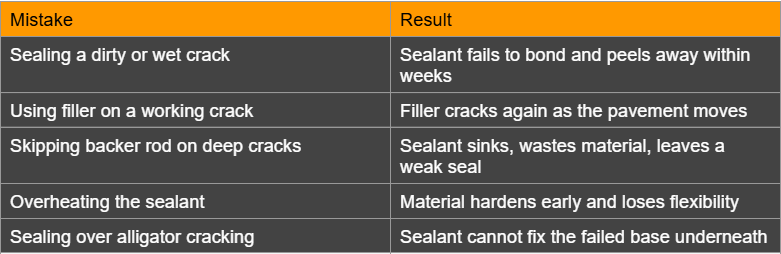
For a handful of narrow, isolated cracks on a home driveway, a cold-pour crack filler from a hardware store can be a reasonable weekend project. Clean the crack, apply the filler, let it cure, and you have bought yourself a season or two of protection.
Commercial parking lots, long or deep cracks, and any pavement with mixed crack types need professional judgment and equipment that most property owners do not own, like a router, hot-pour melter, and heat lance. A professional crew also correctly separates cracks that need sealing from areas that need real repair, which prevents wasted money on treatment that will not hold. Precision Blacktopping handles exactly this kind of assessment and installation for driveways, parking lots, and commercial pavement across Pineville and Central Louisiana. If you want a straight answer on whether your pavement needs sealing or something more, our crack and joint sealing service is the fastest way to get an honest assessment and a free quote.
Professional crack sealing in 2026 generally runs about $0.90 to $1.50 per linear foot for a direct seal, and $1.50 to $3.00 per linear foot when routing is required (Source: TruTec 2026 pricing benchmarks). Small residential jobs often carry a minimum service charge, while high-volume commercial or municipal contracts can bring the per-foot rate down through economies of scale. Crack density, how much routing is needed, and how easy the site is to access all move the final number.
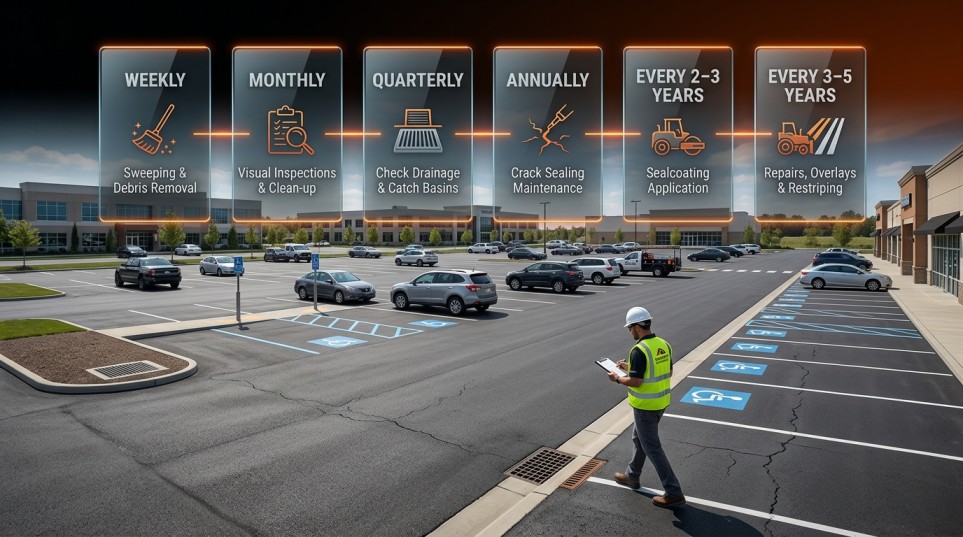
Properly installed hot-pour sealant generally lasts three to eight years, while cold-pour crack filler typically holds up for one to two years. Louisiana's heat and rain sit on the harder end of that range, so routine inspection every year or two helps catch sealant that is wearing out before water gets back in.
Crack sealing targets individual cracks and joints. Seal coating covers the entire pavement surface with a protective layer against UV rays, oil, and oxidation. They solve different problems, and doing seal coating without crack sealing first is a common mistake, since the coating will simply seal water inside an open crack rather than keeping it out. Most professional jobs perform crack sealing first, then apply seal coating over the whole surface for complete protection. Want the full breakdown? Our dedicated seal coating guide covers that comparison in more depth.
Routine Inspection & Cleaning
Walk your pavement twice a year, once in spring and once in fall, looking for new cracks, lifted or cracked sealant, and any standing water after rain. Keep the surface clear of debris and vegetation, since both trap moisture against the pavement.
Repairing New Cracks Promptly
A new hairline crack sealed in the same season costs a fraction of what that same crack costs once it has widened over a full year of rain and heat. Prompt attention is what actually delivers the multi-year lifespan that crack sealing is known for. Waiting resets the clock on the damage, not the cost.
Crack and joint sealing applies to more than just driveways. We regularly seal residential driveways, commercial and retail parking lots, walkways and sidewalks, HOA and apartment community lots, and industrial yards that see heavy truck traffic across the Central Louisiana area.
No. Cracks generally between about 0.1 and 1.5 inches wide qualify for sealing. Alligator cracking, potholes, and cracks wider than roughly 1.5 inches point to base failure and need repair or replacement instead of sealant.
Yes. Properly sealed cracks keep water out of the base layer, which is the main cause of pothole formation. Sealing typically adds three to eight years to pavement life and delays the need for full repaving.
Inspect pavement at least twice a year, in spring and fall, and again after any major storm. Central Louisiana's rain and heat make new cracks appear faster than in milder climates, so regular checks catch problems while they are still cheap to fix.
Professional crack sealing generally runs about $0.90 to $3.00 per linear foot in 2026, depending on whether routing is needed and how much cracking the pavement has. Most contractors also carry a minimum service charge for small jobs.
Yes, for most driveways with isolated cracks under an inch and a half wide. A small sealing job costs far less than a pothole repair or a full driveway replacement, and it protects the investment you already made in the pavement.
Crack and joint sealing is one of the cheapest ways to protect an expensive investment. Central Louisiana's rain, heat, and clay soil put more stress on pavement than most other regions see, which makes staying ahead of cracks even more important here than elsewhere.
The key points to remember: seal working cracks with hot-pour material, fill non-working cracks with a simpler product, and never seal over structural damage like alligator cracking. Catch new cracks early; twice-yearly inspections make the biggest difference in how long your pavement lasts.
Precision Blacktopping has handled crack and joint sealing for driveways, parking lots, and commercial pavement across Pineville and Central Louisiana for years, and we know exactly how our climate wears pavement down. If you have noticed cracks forming or old sealant pulling away, we would be glad to take a look. Contact us for a free crack and joint sealing inspection and quote, and let's protect your pavement before the next storm rolls through.