
August 16, 2026
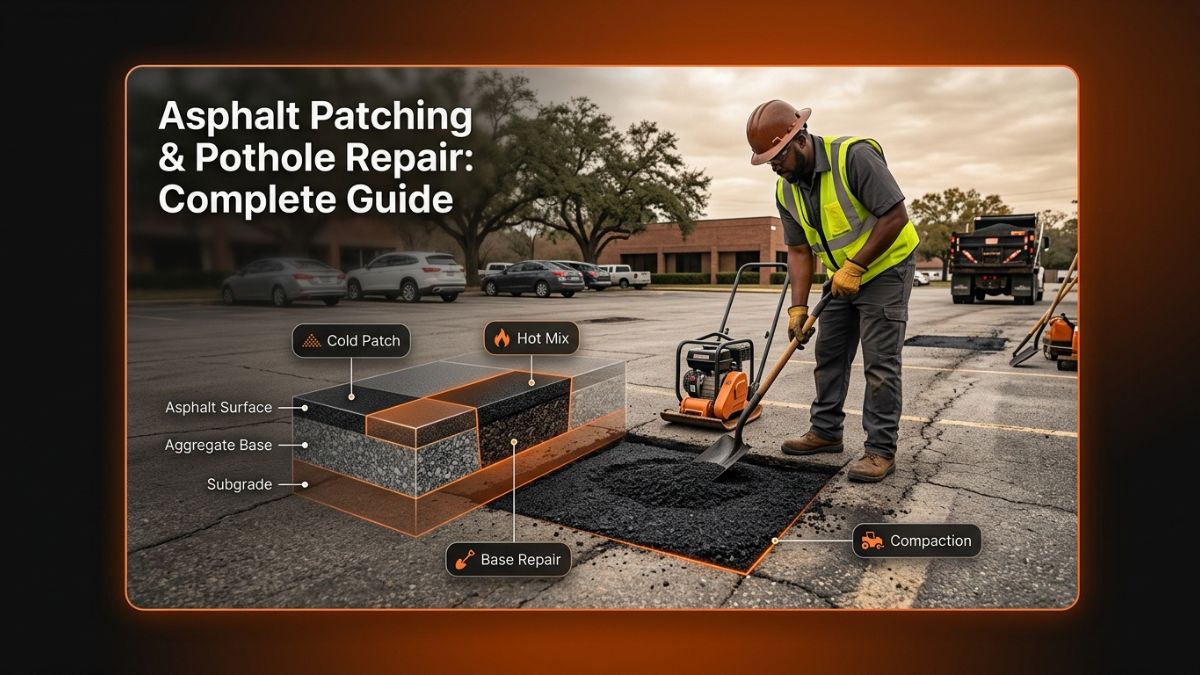
Asphalt patching and pothole repair remove failed pavement from a defined area and replace it with new material. The right approach depends on how deep the damage goes, whether the layers underneath still provide support, how water moves across the surface, and how much traffic the area carries. Isolated damage often patches well. Widespread deterioration usually needs an on-site evaluation before anyone commits to a repair method.
• Depth tells you more than width. A wide but shallow pothole may only involve the surface layer, while a narrow hole that reaches the aggregate base points to a deeper problem that a surface patch will not solve.
• Cold patch and hot mix serve different purposes. Cold patch is generally a holding measure that keeps a hole safe until conditions allow a proper repair, while hot mix placed and compacted correctly is the more durable option.
• Preparation drives patch performance. Federal research on pothole repair found that material quality had more influence on how long a patch lasted than the specific procedure used to place it.
• A pothole that keeps coming back is a symptom, not the problem. Repeated failure in the same spot usually justifies looking at drainage, base condition, or loading before patching again.
• Compare repair quotes by scope, not by square-foot price. A lower number often reflects a shallower repair, less excavation, or a different material rather than a better deal.
A pothole in a driveway is an annoyance. A pothole in a commercial parking lot is a trip hazard, a vehicle damage claim waiting to happen, and a visible signal to every customer who pulls in. Either way, the hole itself is rarely the whole story. Water has usually found a path into the pavement structure, and the surface damage you can see is the point where that process broke through.
This guide walks through what causes potholes in this part of Louisiana, how the common repair methods actually differ, what a proper repair sequence looks like, what drives the cost, and how to tell whether you are looking at a patching job or something larger. It is written for property owners and managers who need to make a decision, not for engineers writing a specification.
Patching is the general term for repairing a defined area of damaged asphalt. It covers everything from filling a small hole to excavating a section of pavement down through the base and rebuilding it. The common thread is that the repair is localized. You are treating a specific area rather than the whole surface.
Asphalt pavement works as a layered system. Beneath the black surface you can see, there is typically an aggregate base course, and beneath that, the subgrade soil the whole structure sits on. Each layer depends on the support of the one below it. That is why patching decisions cannot be made from a photograph. What matters is how far down the failure goes and whether the supporting layers are still doing their job.
In everyday use, people treat the two terms as the same thing, and in casual conversation that is fine. There is a useful distinction, though.
Pothole repair describes fixing a specific bowl-shaped hole where the surface has broken away, and material has been lost. The Long-Term Pavement Performance distress definitions used by the Federal Highway Administration classify a pothole by its minimum plan dimension and rate its severity by depth, which reflects how much the depth matters to the repair decision.
Patching is broader. It includes pothole repair but also covers repairing alligator-cracked areas before they open into holes, fixing failed utility cuts, replacing sunken sections, and correcting areas where a previous repair has come apart. A contractor may recommend patching an area that has no pothole in it yet, because the cracking pattern indicates the surface is close to breaking through.
The practical takeaway: if you only ask for pothole repair, you may get exactly that and nothing more. If the surrounding pavement is already failing, the patch will sit in the middle of deteriorating material and the edges will be the first thing to go.
Potholes generally develop from a combination of factors rather than a single cause. Research on pothole repair materials prepared for state transportation agencies attributes them to gradual damage from traffic, moisture, freeze-thaw action, poor underlying support, or some mix of these. Which factors dominate depends on the site.
Water is the common denominator in most pavement failures in this region. It gets in through cracks, unsealed joints, deteriorated edges, and areas where the surface has oxidized and opened up. Once it reaches the base and subgrade, it weakens the support beneath the asphalt. Traffic then flexes the unsupported surface until it cracks apart and material is pumped out.
Central Louisiana adds a few complications. Rainfall here is heavy and often arrives in short, intense events, which puts a lot of water on a surface in a short time. Many local sites also have soils that hold moisture and change volume as they wet and dry, which affects the support under the pavement. Flat sites drain slowly, and a low spot that holds water after a storm gives that water time to work into the structure.
None of this means your drainage is failing. A single puddle after a heavy rain does not prove a design problem. But standing water that persists in the same location after every rain, especially near existing cracking, is worth having looked at before you spend money on repairs that sit in that same low spot.
Traffic loading is not evenly distributed across a parking lot. Delivery truck routes, dumpster approaches, drive-through lanes, and entrances carry far heavier and more concentrated loads than parking stalls. Those are usually where potholes appear first, and it is not a coincidence.
When the base or subgrade provides less support than the loading requires, the asphalt above flexes more than it was built to. Repeated flexing produces fatigue cracking, often in the interconnected pattern people call alligator cracking. Once that pattern opens up, water reaches the base easily and pieces begin to break loose.
This matters for repair selection. A surface patch placed over an area where the base is not supporting the pavement is likely to fail in a similar way to the original damage. That is not a reason to assume your base has failed. It is a reason to have someone evaluate the depth of the problem before choosing a method.
Central Louisiana does not see the deep freeze-thaw cycling that drives pothole season in northern states, though brief freezing spells do occur here. What this climate provides instead is sustained heat, strong UV exposure, high humidity, and frequent rain.
Sustained sun exposure oxidizes the asphalt binder over time, which makes the surface more brittle and more prone to cracking. Those cracks then admit water. Heavy rain saturates the structure. Hot pavement expands and contracts through daily temperature swings. The result is a slower, wetter version of the same damage cycle, and it means crack maintenance carries real weight here even without hard winters.
Timing also shifts because of the rain. Extended wet stretches make it hard to get a dry, clean surface, and patching into a wet hole compromises the bond. Repairs often get scheduled around the weather rather than around the calendar.
There is no single best patching method. Each one trades durability against speed, cost, and the conditions you can work in. The table below summarizes the common approaches. Note that several of these are industry methods included for completeness, not a list of services offered by any one contractor.
Two points about that table are worth expanding.
A temporary repair exists to make a hazard safe right now. It buys time. It is the right call when someone could get hurt, when the weather will not allow proper work, or when a larger project is already scheduled, and you need the lot usable in the meantime.
A permanent repair removes the failed material, addresses what is underneath where necessary, and replaces the section with material placed and compacted to hold up under the traffic it will carry. It costs more and takes longer.
The mistake worth avoiding is treating a temporary fix as a permanent one because it looked fine after a week. Cold patch pushed into a wet hole and driven over will often hold through a dry spell and come apart during the next stretch of heavy rain. If a repair was placed as a stopgap, plan for the real one.
Hot mix asphalt generally produces the more durable repair. It is placed hot, compacted while workable, and bonds to the surrounding pavement in a way cold patch usually does not match. It requires the material to be available and hot on arrival, and it requires workable weather.
Cold patch is stockpile material that stays workable at ambient temperature. Its advantage is availability. You can place it in conditions where hot mix is not an option, which is precisely why agencies use it for emergency and winter repairs.
There is a nuance here that most contractor blogs miss. Federal research on pothole repair, conducted through the Strategic Highway Research Program and continued under the FHWA Long-Term Pavement Performance program, compared different material and procedure combinations across test sites. A significant finding was that the quality of the patching material had more effect on how long the repair lasted than the procedure used to place it. Applied practically, that means a well-made cold patch material placed carefully can outperform a cheap material placed with a more elaborate procedure. It does not mean cold patch equals hot mix in every situation, and it does not mean preparation stops mattering.
The sequence below describes how a proper localized repair is generally carried out. It is written so you understand what should be happening and can recognize when steps are being skipped. Some of this work involves hot materials, saw cutting, and compaction equipment. Those tasks belong to trained crews with the right protective equipment.
Start by establishing how deep the hole goes and how far the damage extends beyond the visible edge. Probe the bottom. If loose aggregate or soft material is present, the failure has reached below the surface course, and a surface patch will not be enough.
Look at the pavement around the hole as well. Interconnected cracking around the perimeter usually means the sound edge is farther out than it appears. Repair boundaries should be placed in intact pavement, not in material that is already breaking down.
Standing water and loose material have to come out. New material will not bond to a wet, dirty surface, and debris left in the bottom of the hole becomes a void once traffic works it loose.
Edges should be squared so the sides are vertical and the repair meets sound pavement all the way around. Guidance on hot mix patching describes squaring the sides so they are vertical with intact pavement on all sides, which gives the new material a defined shape to lock into. Ragged, tapered edges are one of the most common reasons patches fail from the outside in.
If the excavation reveals soft, saturated, or contaminated base material, that material needs to be removed and replaced with suitable aggregate, then compacted, before any asphalt goes down. Skipping this step is the single most common reason a technically correct-looking patch fails within a season.
Whether this step applies to your repair depends on the site. It is not required on every job, and no one can tell you it applies to your driveway without opening it up or evaluating it in person.
A tack coat is a light application of asphalt emulsion on the vertical faces and floor of the excavation. Its purpose is to help bond the new material to the existing pavement so the repair behaves as part of the surface rather than a plug sitting in a hole.
The patching material is then placed. It is typically mounded slightly above the surrounding grade so that it finishes flush after compaction, since the material reduces in thickness as it is compacted.
Compaction is where a lot of repairs are won or lost. Deeper repairs are placed and compacted in layers rather than in one thick lift, because a thick lift cannot be compacted uniformly through its full depth.
The specifics of compaction, including lift thickness, equipment, rolling pattern, and material temperature, depend on the mix, the weather, and the size of the repair. There is no universal number that applies to every job. What matters from your side is that layered placement and thorough compaction happened rather than material being dumped in and driven over.
A finished patch should sit flush with the surrounding pavement. A patch that ends up high creates a bump and takes concentrated impact from every tire that hits it. A patch that ends up low collects water, which puts you back where you started.
Edges should be tight, and the joint between old and new pavement should be closed. This joint is the most vulnerable part of any repair and deserves attention.
How long to stay off a fresh repair depends on the material used, the weather, the depth of the repair, and how it was placed. Hot mix generally needs time to cool before traffic loads it. Some cold patch materials are intended to accept traffic quickly, which is part of their appeal.
Ask the contractor who performed the work for their specific instruction rather than applying a rule you read online. Follow that instruction, particularly regarding heavy vehicles, turning traffic, and parking in one spot on a warm day.
Understanding what a proper repair requires helps you evaluate whether a quote reflects real work or a quick fill.
The core materials are the patching mix itself, aggregate for base replacement where the repair goes deep enough to need it, and asphalt emulsion for tack coat. Material selection is not a minor detail. As the federal research noted earlier indicates, material quality carries substantial weight in how long a repair holds up.
For homeowner-scale work, bagged cold patch is what is realistically available. It is suitable for small, shallow holes. It is not a substitute for a structural repair, and buying a better grade of it will not change that.
Preparation typically involves a saw or cutting equipment to square the edges, tools to remove debris, and a means of drying the area. Compaction may involve a plate compactor for small repairs or a roller for larger ones, sized to the work.
For a small driveway repair, a hand tamper or rented plate compactor can produce an acceptable result. Driving over the patch with a vehicle is not compaction and will produce an uneven surface that fails early.
Weather affects patching more than most people expect, and the rules of thumb people repeat are often stated more absolutely than the underlying practice supports.
Better conditions for a hot mix repair are generally dry, with a dry existing surface, moderate ambient and surface temperatures, and no rain in the immediate forecast. Cooler air and a cold existing surface pull heat out of the material faster and shorten the window available for compaction.
The precise temperature limits depend on the mix, the size and depth of the repair, haul distance, wind, and any governing specification. A number that applies to one repair does not necessarily apply to another, which is why an experienced crew makes that call on site rather than from a chart.
After rain: the repair area needs to be dry before material goes in. Trapped moisture interferes with bonding and stays in the repair. Central Louisiana’s rainfall patterns mean waiting is often part of the job. A contractor who tells you they need a dry window is describing how the work is done, not stalling.
In extreme heat: hot weather generally helps hot mix stay workable, but a very hot existing surface and fresh material can stay soft longer, which affects when the repair can carry traffic. Deep summer heat also affects worker safety and scheduling.
In cold: cold conditions shorten the compaction window for hot mix considerably. This is where cold patch earns its place as a hazard-control measure until conditions improve.
When a patch fails early, the cause is usually identifiable, and it is usually one of three things.
Material placed into a hole that still holds water, loose debris, or soft base will not perform, no matter how good the material is. Ragged edges left uncut give the patch nothing solid to bond against, and the perimeter starts breaking down almost immediately.
Base problems left unaddressed produce the most frustrating version of this. The patch looks correct for a while, then settles or cracks in the same pattern as the original damage, because the same lack of support is still there.
Under-compacted material contains voids. Voids admit water and allow the material to move under load. The surface may look finished while the repair is not.
Method mismatch is the other half of this. A surface patch applied to damage that extends into the base treats the symptom. It is sometimes a deliberate, reasonable choice when budget or timing requires it, but it should be a decision you make knowingly rather than something you discover a year later.
If potholes keep returning to the same area, patching alone is unlikely to end the cycle. Recurrence in one location is worth investigating for water reaching the structure, a low area holding water, base or subgrade conditions, concentrated loading, or how previous repairs were prepared.
Correcting drainage is separate work from patching, and it should be described separately in a quote. Precision Blacktopping LLC includes drainage correction within its parking lot maintenance work, which matters on Central Louisiana commercial sites where water sits after heavy rain.
These four options sit on a scale, and the correct one depends on how much of the pavement is affected and what condition the supporting layers are in.
Patching suits localized damage where the majority of the pavement is still performing. It is the least disruptive and least expensive option, and it does nothing for problems outside the repair area.
Milling removes a defined depth of existing surface material. It is often used to manage elevation at transitions, remove deteriorated surface material, and prepare a surface before new asphalt is placed.
Overlay or resurfacing places a new asphalt layer over the existing pavement. It suits widespread surface deterioration where the underlying structure is still sound. An overlay does not correct failed base, severe fatigue cracking, or drainage problems on its own, though localized repairs are frequently completed before an overlay so those areas do not reflect through. Precision Blacktopping’s asphalt resurfacing service covers this work.
Replacement or reconstruction removes and rebuilds the pavement structure. It is considered when failure is extensive and deep enough that surface treatments cannot restore performance. Age alone is not a reason to reconstruct.
The honest answer for most properties is that the right choice depends on what a walkover and, where warranted, some investigation reveal about the extent and depth of the damage. That is what an on-site assessment is for.
Anyone quoting a firm price for pothole repair without seeing the pavement is guessing. What can be described accurately are the variables that drive the number.
• Total repair area, which usually matters more than the number of individual holes, since a single larger repair is often more efficient than several scattered small ones
• Depth of the repair, because removing and replacing more material costs more
• Whether base repair is required, which adds excavation, aggregate, and compaction
• Method and material, including whether the repair is a hot mix repair, a cold patch stopgap, or a full-depth reconstruction of the area
• Access and site conditions, including whether equipment can reach the area and whether traffic needs managing around it
• Mobilization, which is why a single small repair rarely costs proportionally less than a larger one
• Related work, such as drainage correction, crack sealing, or restriping after the repair
Residential driveway repairs are typically smaller in area and lighter in loading, and they are often quoted as a single item. The practical challenge is that mobilizing a crew for one small hole carries a cost that does not shrink with the repair. Grouping repairs, or timing them alongside other planned work, usually produces better value.
Commercial parking lot repairs vary more widely. A lot may need patching in a truck route and nothing in the parking stalls, or scattered repairs across several zones. Commercial quotes may also include traffic management, phased scheduling to keep the business open, and restriping where markings are disturbed.
When you compare quotes, compare scope line by line. A lower number frequently reflects a shallower repair, no base work, a different material, or a smaller repair footprint. That may be exactly what you want, but you should know that is what you are buying. Precision Blacktopping provides free on-site estimates with a written, itemized scope, which makes that comparison possible.
No one can tell you how long your patch will last, and any specific number offered without seeing the site is not a meaningful commitment. Service life depends on the repair method, material quality, preparation, compaction, traffic, drainage, and the condition of the surrounding pavement.
What can be said with confidence is the relative ordering. A cold patch stopgap placed in poor conditions is the shortest-lived option. A properly prepared, compacted hot mix repair on a sound base lasts considerably longer. A full-depth repair that addresses failed base material generally lasts longest among localized repairs, because it removes the cause rather than covering it.
Federal research comparing material and procedure combinations reinforces why material selection deserves attention alongside method. It is also worth separating two ideas that get conflated: a workmanship warranty covers the quality of the work performed, which is not the same as a prediction of service life. Precision Blacktopping LLC backs its work with a workmanship warranty, and the specifics are worth discussing when you get your estimate.
The last one is the most informative. A patch that fails in the same way as the original damage is telling you that whatever caused the first hole was never addressed.
Potholes rarely appear without warning. They develop from cracks, from water, and from small problems that had time to grow. Maintenance is genuinely cheaper than repair, though it is worth being clear about what each treatment does and does not do.
Sealing cracks while they are still narrow and isolated keeps water out of the pavement structure. Since water reaching the base is central to how most potholes form here, this is the highest-value routine maintenance most properties can do.
Crack sealing has limits. It cannot repair widespread fatigue cracking, failed base material, or structural distress. When cracking has already spread into an interconnected pattern, the situation has moved past what sealing addresses. Precision Blacktopping offers crack and joint sealing as a standalone service and as part of parking lot maintenance programs.
Sealcoating applies a protective coating over the asphalt surface. It helps shield the surface from UV exposure, water, and chemical spills, and it restores appearance. In this climate, where sun exposure drives oxidation, it is a reasonable part of a maintenance program.
Be clear about the boundary, though. Sealcoating is a surface treatment. It does not repair potholes, restore structural capacity, or fix a failing base. Structural repairs come first, then sealcoating. You can review Precision Blacktopping’s seal coating service for details on scheduling.
A regular walkover catches the small stuff. Look for new cracking, especially interconnected patterns in truck routes and entrances. Note where water stands after rain and how long it takes to clear. Watch existing patches for edge separation. Check that inlets and drainage paths are not blocked with debris and that landscaping has not altered how water leaves the pavement.
Documenting what you find and when gives you something useful to hand a contractor. Photos of the same area over several months tell a clearer story about whether a problem is progressing than a single visit ever will.
There is a real place for homeowner repairs, and there is a clear line where the work stops being reasonable to take on yourself.
A small, shallow hole in a residential driveway, where the material underneath is firm and dry, and the surrounding pavement is in decent shape, is a reasonable project. Clear out all loose material and water, square the edges as best your tools allow, fill in layers rather than all at once, and compact each layer properly.
Keep it in perspective. This is a good outcome for a small hole and a temporary result for anything larger. Wear eye protection and gloves, keep the work area clear, and do not attempt anything involving hot materials or heavy equipment.
Bring in a contractor when:
Precision Blacktopping LLC is a family-owned paving contractor based in Pineville, Louisiana, with three generations and over 50 years in the business. The company is licensed and insured, provides pothole patching and repair as part of its parking lot maintenance work, and assesses each repair to determine whether a surface repair or a deeper structural repair is appropriate.
To have your pavement looked at, call (318) 955-3100 or request a free estimate. The on-site assessment is free and comes with a written, itemized scope so you know exactly what is being proposed before any work begins.
There is no fixed maximum. What changes with depth is the method. Shallow damage confined to the surface layer can be handled with a surface repair. Damage that reaches into or through the base generally calls for a full-depth repair, where the failed material is removed and the area is rebuilt. Deeper repairs are placed and compacted in layers rather than in a single lift. The depth question is really a question about what is underneath, which is why probing the bottom of the hole matters more than measuring across the top.
For a lasting repair in workable conditions, hot mix is generally the stronger choice. Cold patch is the practical option when weather rules out hot mix or when a hazard needs controlling immediately. Federal research found that material quality influenced patch performance more than the procedure used, so a good cold patch material placed carefully will outperform poor material placed elaborately. That is a reason to take material selection seriously, not a reason to treat cold patch as a permanent solution.
You can patch after rain once the area is properly dried out. You should not patch into standing water or saturated material, because moisture interferes with the bond between new and existing pavement and stays trapped in the repair. In Central Louisiana, this frequently means scheduling around the forecast. If a hole is a hazard and the weather will not cooperate, a temporary cold patch is the reasonable interim step, with a proper repair scheduled when conditions allow.
That depends on how much of the pavement is affected and how deep the damage goes, not on how old the pavement is. Localized damage on a surface that is otherwise performing is a patching situation. Widespread deterioration with sound underlying structure often points toward resurfacing. Failure that is both extensive and deep is where replacement enters the conversation. Making that call properly requires someone to walk the site, look at the drainage, examine the cracking patterns, and in some cases investigate below the surface.
Potholes are the visible end of a process that started somewhere else, usually with water finding a way into the pavement structure. That is why the most important question is not which patching product to buy but how deep the damage goes and what is happening underneath.
If the damage is localized and the supporting layers are sound, a properly prepared and compacted patch is a sound investment. If potholes keep returning to the same spot, or if cracking has spread across the surface, the conversation shifts toward drainage correction, resurfacing, or a larger repair. Preparation, material quality, and compaction determine how long the repair holds. Scope, not square-foot price, is how you should compare quotes.
Precision Blacktopping LLC serves property owners and managers across Central Louisiana from its base in Pineville. To find out what your pavement actually needs, call (318) 955-3100 or request a free estimate. The on-site assessment costs nothing and gives you a written scope you can act on.
Sources referenced for technical claims:
• Federal Highway Administration, Materials and Procedures for Repair of Potholes in Asphalt-Surfaced Pavements (FHWA-RD-99-168) — repair methods and long-term performance findings
• FHWA Long-Term Pavement Performance program — pothole distress definitions and severity classification by depth
• FHWA / SHRP maintenance research — finding that patching material quality had greater influence on patch performance than repair procedure
• FHWA-NJ-2024-001, Innovative Pothole Repair Materials and Techniques — contributing causes of pothole formation
.png)